The real gag will be tumblr doing all this and still not getting back on the App Store
Category: Uncategorized
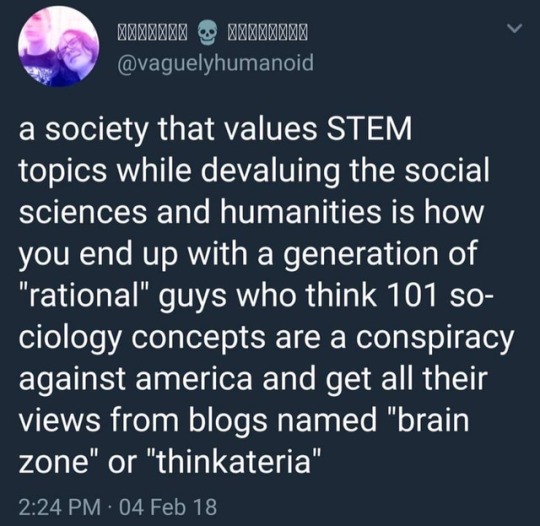
ive been reading a book that basically explains how so-called “brain differences” between the genders is the result of gendered socialization and not the cause of it. i honestly expected the book to be very cis-centric but its actually the opposite, the author stresses that testimony from trans ppl is actually indispensable because we’ve, in a sense, “lived both experiences”
more cis feminists should have this mindset
one of the first examples that she uses to introduce her point about how perception by others can shape a person’s performance actually uses a trans woman. it explains that as a certain trans woman became to be seen as a woman more and more frequently, the ppl arond her eventually started viewing her as being ill equipped for tasks that they did not bother her about pre-transition. eventually she even found herself underperforming in these tasks herself.
whats the name of the book
Delusions of Gender by Cordelia Fine
I knew it was this book before I’d finished reading the first two lines. Honestly this book is indispensible if you want to debunk any gender determinism people claim is science. I can’t recommend it enough.
She’s written a new one! It won the Royal Society prize for science book of the year, and it’s called Testosterone Rex, and it is excellent.
(Bonus: it’s making old white men really really mad.)
(Bonus bonus: I am myself a neuroscientist, and the old white men mentioned above – who are not – could not have missed the point harder if they’d actively tried. Which. Maybe?)
people making jokes about how this tumblr ban on adult content is the fault of ace people or saying that they wanted it are pathetic.
And look at that, I’ve already seen someone say that ace people are actually saying this. It’s funny how the first three posts in the ace discourse tag are exclusionists making these jokes and the fourth is someone complaining about the hypothetical ace people who could do that. Since when is it okay to make up an attitude someone else could have based on a shitty stereotype of their orientation you’ve also made up, then get angry and act like the boogyman you conjured was their fault?
Literally exclusionists will play themselves so fucking hard as long as it means they can dunk on ace people. anyone capitalizing on tumblr’s shitty ban to fuel the ace hatred needs to take a strong look at how fucking contrived they’ve become. If imaginary ace people saying the tumblr ban is good is awful bigotry, you better believe using this opportunity as a joke to spread malicious rumours is too.


Let’s Talk About Crabs and Buckets.
If you put a single crab into a bucket, it will climb out and escape from becoming someone’s dinner.
If you put a whole bunch of crabs in a bucket, however, the crabs in the bottom of the bucket will pull the crabs at the top of the bucket back down if they try to escape. Instead of allowing some or all of the crabs to survive, the group of crabs will ensure that every single one of them ends up on a plate.
This same phenomenon is seen in human communities, where it has become known – appropriately – as crab bucket mentality. From the outside, these crab bucket communities might look like support groups, or places to get feedback and advice. But in reality, they are black holes – these are communities where people go to tear each other down, and to actively be torn down in return. Instead of lifting each other up, these communities burrow further and further into their buckets, until everyone is too bitter and broken to ever climb out.
And you might be part of a crab bucket community without even knowing it.
Some online communities are obvious crab-buckets. The so-called “incel” community might be the most obvious example; these are angry young men who tell each other over and over again that they are worthless, unattractive, and that they will never be loved. Lonely teenagers enter the incel community to talk about how frustrated and insecure they are after dealing with romantic rejection, and they quickly find themselves pushed toward hopelessness, violent misogyny and suicidal fantasies. Likewise, the “pro-anorexia” and “thinspo” communities are crab buckets, where members encourage each other to adapt more and more extreme disordered eating, and often invite other members to make cruel comments about their bodies and food journals. Insecure young women (and some men) go to these communities because they want to like their bodies more, and end up weighed down with self-hatred.
But not every crab bucket is obvious.
Although there are lots of wonderful and supportive spaces online for LGBTQ+ people, the internet is also littered with LGBTQ+ crab buckets – especially for trans people. Some trans communities are almost entirely dedicated to discouraging and criticizing other trans people for not “passing”; these communities will pore over each others’ pictures, pointing out lingering masculine or feminine features, comparing each other to “a man in a dress”, or outright convincing each other that there is no point in transitioning, as they have no hope of ever “passing”. Anxious trans or questioning people join these groups to navigate a very difficult time in their lives, only to have their own insecurities magnified and distorted.
Communities and feedback circles for writers and artists can also be crab buckets. Again, while there are wonderful and supportive spaces available, there are also toxic black holes out there, masquerading as genuine communities. I’ve belonged to writers’ groups where every single piece of writing was viciously torn to shreds, no matter how promising it might have seemed, and there were constant discussions about how ‘pointless’ it was to try to get published. Members were so insecure about not “making it” that they frantically tried to crush the hopes and dreams of anyone who might be competition. Instead of producing better writing, these kinds of groups eventually produce no writing at all.
Activist communities are often crab buckets. On the surface, people join activism communities to lift each other up and feel less alone in their cause; in reality, however, many activist communities have underlying cultures of suspicion, gossip, and hostility. Members gleefully comb through each other’s posts and content carefully, constantly looking for any small mistake or out-of-context comment that will allow them to declare that someone is “trash” or “cancelled”. People join these causes to fight back against their own feelings of powerlessness, and often report developing anxiety, depression and panic attacks as a result.
The list of crab bucket communities goes on. Any kind of group can become a crab bucket group under the right conditions; just because a community is created by and for a marginalized identity, it doesn’t mean that that community is actually safe for that identity. As humans, we like to band together in groups to accomplish large goals and feel less alone… but sometimes, we turn those groups into echo chambers for our own toxic ideas, and try to drag as many people as we can down into our buckets of despair with us.
If you’re in a group that you suspect might be getting a little crabby, it’s probably time to leave. Turning a whole group around by yourself is an enormous and thankless task, and it’s not one that I’d wish on anybody. Once a group of people have formed a collective identity around proving why they’re all worthless or fat or problematic, it’s hard to turn that ship around, and any attempts to do it might be met with hostility. It’s okay to give up on toxic communities, and look for healthy ones that build you up instead of tearing you down.
It’s okay to climb out of the bucket.

They could have just said bare breasts
 Sepulchritude Tumblr Backup